Japanese learning resources
At the end of June 2024, I started learning Japanese.
Before that, I had spent years thinking that I would probably get to it someday due to my constant exposure to manga and anime and my interest in translation choices; but I was unsure whether it would actually come to fruition at any point. It was a vague, passive desire, some "yeah, it'd be nice if I could" for the longest time - but the idea of actually starting felt like work, somehow, something I didn't feel ready to integrate into a routine. It was just part of an idealized future self.
And then, in Spring 2024, I suddenly stumbled onto toki pona, one of the world's smallest constructed languages, and I realized that dang, learning a new language is so much fun. And I had forgotten that! I didn't know I had that euphoria in me!
But I did. Learning very basic tools that give you the ability to confusingly decipher new things, and then coming back to those same things regularly and realizing you're understanding them a little bit more each time, is a fantastic experience. Figuring out a new language, its common sentence structures, how some of its specificities allow it to convey things that other languages can't that easily, is like unlocking something entirely new.
And so, after two months on toki pona, which notably provided me with a firmer grasp on how some words or logograms can have very broad and versatile meanings, I thought that I may as well apply that whole feeling of euphoria about words and languages to Japanese. And so I started. Without ever thinking that I was Learning Japanese with a capital L, or aiming for anything in particular. Just because it was fun, and I could do it1.
However, no Japanese course was easily available to me IRL; and I didn't trust Duolinguo2 or any similar thing to teach me more than basic vocabulary in the form of menial tests. What I wanted was to understand how Japanese worked, because that felt like a fun puzzle to fry my brain with. So I looked for what I could find online disseminated across blogs and neocities websites instead3.
And I did find a lot of things, made by people who cared about providing to others what had worked for them.
And now, two years later, I want to pay this forward.
A few disclaimers, though: I am, very obviously, still learning. My focus is much more on understanding Japanese than it is on speaking or writing it, because this is what motivated me from the start. What worked for me may not work for you at all.
But hey, here's a bunch of resources anyway. Who know? Maybe a few of them will catch your eye and will help you get a foothold in this.
0 - If you want a fully contained learning method that feels like playing a game...
... I'll redirect you wholeheartedly to Wagotabi, a small RPG that teaches you Japanese from scratch, step by step, as your character travels through a pixel-art, simplified version of Japanese prefectures. NPCs provide you with bite-sized lessons, and challenge you to increasingly difficult battles to test what you've learned so far.
The game wears its Pokémon inspiration on its sleeve, I found it at some point of Fall 2024, and I really really liked it - I just kept being impressed with how well it was structured, and how much content was in it.
I started when it was still in early access and was able to download it for free, but it officially released last summer and now it costs a few euros (or bucks or whatever); but I still wanted to put it here somewhere.
To be clear, it doesn't fully replace everything I list below: it teaches you stuff purely on a need-to-know basis, so that you will end what is currently available in the game (which is already a lot!) without knowing all of the katakana, for instance.
But both its vocabulary and grammar lessons are great, and so is the way the game helps you assimilate all this knowledge - and honestly it goes quite far, as it even teaches you many adjective and verb conjugations and how to make complex sentences. It's been an extremely engaging tool for my early learning period, and it's provided me with some very solid foundations.
... Alright, this section is starting to sound like a sales pitch. It's not my intention; I just really like this game.
Moving on to the resources.
I - Hiragana and katakana
Japanese uses three different scripts: hiragana (simple, curved characters like の), katakana (simple, angular characters like ア) and kanji (more complicated characters like 月 or 愛). In the first two, together called the kana, each character represents a syllable - which is just a specific sound4 without any particular meaning by itself.
You need to start with the hiragana and katakana. In just a few weeks, they should allow you to decipher stuff like English loanwords in Japanese (which use katakana), several simple words, or to locate the grammar-related particles of a sentence (which use some specific hiragana, see the next section). You won't get the meaning of most of it without vocabulary, but you'll be able to read the pronunciation of many written words! And honestly, spotting loanwords and possibly infering their meaning is already a fun and fascinating thing5.
You can learn the kana from pure, rote memorization if you really want; just pull out a table of hiragana, a table of katakana, and you're all set up.
But what I've found more effective on me was to use mnemonics. I relied on the ones from Tofugu (here for hiragana, here for katakana) which are, as all mnemonics are, various levels of silly... but they work. After some point you just know any given character and don't need them anymore; but in the meantime this helps you assimilate a lot of characters faster.
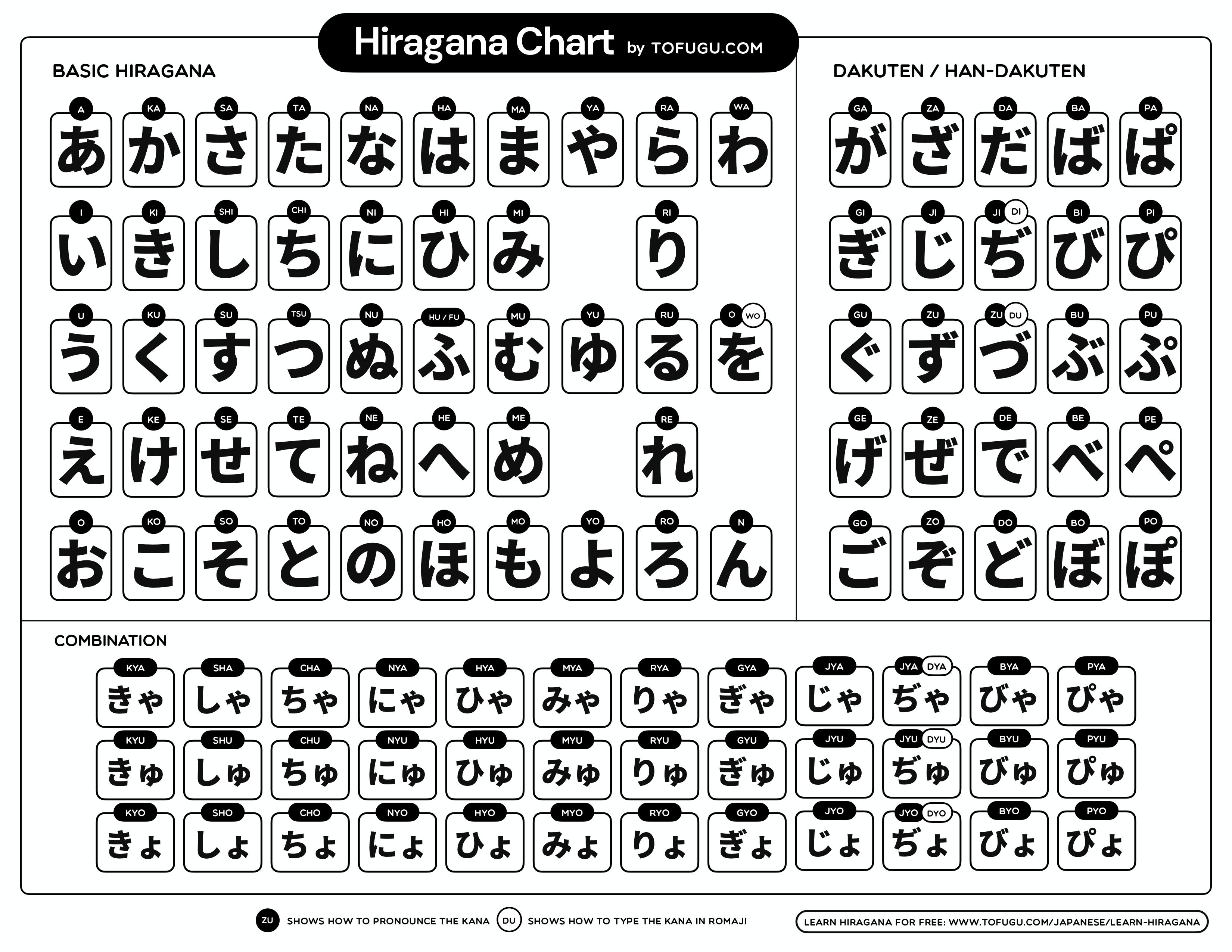
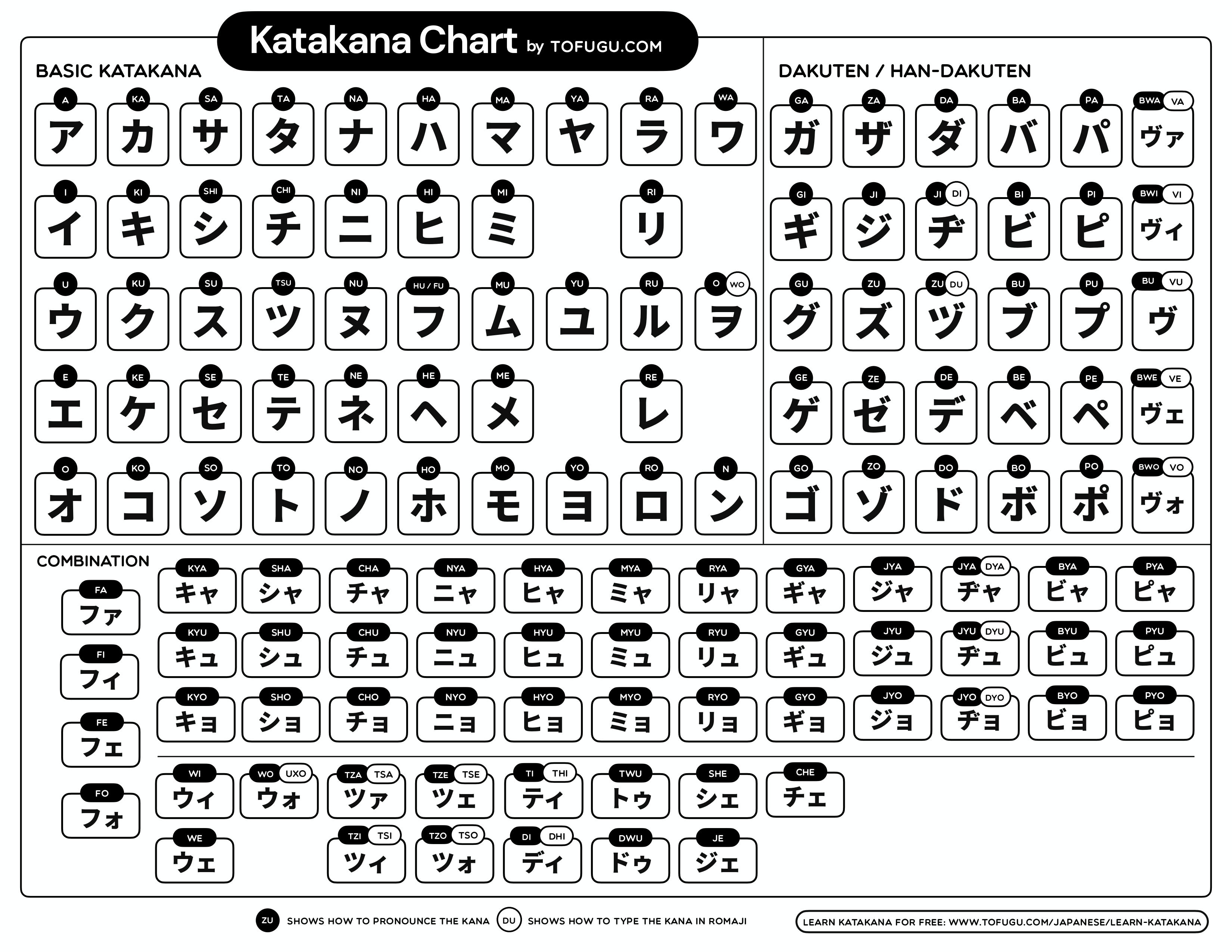
I also recommend pacing yourself. The trick is to learn all those characters by groups of five, because this is how they are organized. First a/i/u/e/o, then ka/ki/ku/ke/ko, then sa/shi/su/se/so... I started with hiragana, adding five new characters a day (or a half-day, sometimes), and eventually moved on to katakana to do the same.
There are around 50 hiragana, and same for katakana (the two syllabaries are in correspondance, not unlike how English technically uses two Latin scripts, for lowercase and for uppercase).
You also need to learn about the "dakuten", the little marks that change pronounciation from た "ta" to だ "da", or from さ "sa" to ざ "za" - they turn a voiceless consonant into its voiced counterpart, if that makes sense, and they're honestly rather easy to understand once you get how they transform each sound. The last extra thing is a bunch of specific combinations of two characters, using smaller versions of the second character: they're what turns じや "jiya" into じゃ "ja" for instance.
It may sound a bit daunting, but it's not: you'll just be expanding day by day what you can read, and in just a few weeks you'll be able to decipher two new scripts!! How cool is that?
The last piece of advice here is to train regularly. I used two things for that:
- this extremely useful page by DJT Kana: just check the groups of characters you've learned, possibly a font you're comfortable with, and just type the transcription of the character currently being displayed, randomized from the ones you've selected. I find this format almost addictive, and if you do this a few minutes each time you're idle during your day you'll have them all memorized in no time.
- and this broader quiz by Tofugu, where the website asks you to transcribe the pronunciation of all the characters you've selected, which is useful when you want to make one big test at the end of a day.
That's it! At some point you'll be doing those quizzes rather easily, and you'll know it's time to move on to the next thing: grammar.
II - Grammar
In this section, I'll provide what worked for me on particular points of basic Japanese grammar. That being said, when making more research recently I also found the website Bunpro, which seems honestly extremely methodical - if a bit dry - in introducing new grammar tools lesson after lesson. I don't necessarily recommend using only that, because it feels a bit barebone by itself, but something with such a step-by-step structure may be very useful to track your progress and have a summary of every grammatical element you learn - and I'll probably read more of it myself at some point, to improve my own grammatical blind spots.
So far, when learning grammar from the scratch, my two main tools have been Tofugu's grammar section and the blog 80/20 Japanese6. I've also skimmed tidbits of Tae Kim's grammar guide, that I've seen recommended a few times - but not much, as it's been a bit too dense for me to stick with it. But as a consequence, my links in what follows will be from these three things.
The first thing I heavily recommend before anything else is the sentence structure diagram from this 80/20 Japanese post: I think it gives you an extremely concise and clear overview of how most sentences work. It's helped me tremendously in covering efficiently which particles are used to provide what kind of information in a given sentence.
Here are, in my opinion, the other most basic tools you will need:
- the です "desu" copula, the main word you may have noticed at the end of a lot of Japanese sentences. Tofugu's approach to explain it has been the most effective on me.
- verbs! they're not very hard: there are basically two main types of verbs, and like three exceptions to this, and honestly pretty much everything about all that is very efficiently summarized on the cheat sheet from this post.
- adjectives! there are two kinds, the i-adjectives and the na-adjectives, which work a bit differently. Here are some good recapitulative tables on how to express state of being first with a noun, and then with both both na- and i-adjectives. These will give you the essential word endings you'll need to put any word that is not a verb to a past tense and/or negative form. (Tofugu's guides also work here if you prefer, though they lack a recapitulative table.)
- additional particles like the particle の "no", used to turn nouns into labels modifying other nouns, or to nominalize non-nouns; and the particle も "mo" to introduce an additional sentence topic.
- the two sentence-ending particles that are よ "yo" and ね "ne": both 80/20 Japanese and Tofugu cover them quite well.
- and finally, pronouns, which carry entire meanings of gender and social etiquette; once again Tofugu covers the basics well (and has more details on first-person pronouns in particular).
And with that, you have all the basics of grammar in less than ten webpages!
Of course, you can dive deeper starting from there, into things like the differences between some pairs of particles (like wa and ga, or ni and de), recommended ordering of information, how to articulate sentences together or to build noun phrases to form complex sentences, etc etc.
I also believe that a lot of finer grammar elements can be learned as you go once you get the aforementioned basics, notably as part of your vocabulary learning. Don't get stuck reading all the lessons of a website at once: with all of the above and a few basic words, you'll have enough tools to understand a lot of stuff... and to learn more grammar elements as you're exposed to actual Japanese sentences! And when doing so, if you encounter new grammar elements you're curious about, the search functions of Tofugu and Bunpro's grammar guides are honestly lifesavers, so I'm putting the links here again.
III - Vocabulary + kanji
First, a few words regarding kanji. Kanji felt scary at first - there are so many! they can have wildly different pronunciations depending on the context! - but they've become one of my favorite language features over time. Because you don't need to know how a kanji is pronounced in a specific sentence to vaguely know what it means. With some basics of grammar and vocabulary, it's easy to look at a sentence and be "ok, so this is a verb, and it uses this kanji, and I have no idea how to say this but it's definitely related to that concept". And a lot of the time, it works!
Also, through your exposure to kanji, you'll get used to breaking down a given kanji into its radicals, its essential parts; and sometimes this'll give you some broad hints as to what the kanji is related to: 扌often links the kanji to actions using a hand (as a squeezed version of 手, te, hand), 艹 links it to grass (as in 花, hana, flower), 氵links it to water (as in 海, umi, sea)...
Now, this is the part of your learning where you install Anki, a well-known spaced repetition app: you have a deck of "cards" with Japanese vocabulary you want to learn on one side, and the English translation on the other side - and you're regularly asked to review some portion of your current deck by trying to recall each translation. The more you memorize a card and get it right, the less Anki makes you review it; and simultaneously the app introduces more and more cards into your deck so that you expand your vocabulary while reviewing regularly the words you're still learning.
This method is great for learning things. It also requires sticking to it, at least for a few months.
Here is what I did.
- I installed Anki (on my mobile, but there are desktop versions too);
- I set up a deck based on the JP1K method, something that doesn't confront you to isolated kanji and vocabulary, but instead gives you a target word to identify inside a full sentence (with kanji reading available as help if necessary). This makes you read (and hear! there's sound too!) actual sentences, and it familiarizes you with the grammar - I find it much more helpful and interesting in the long run than pure kanji flashcards.
- The exact deck I used has become deprecated, but as far as I can tell this is the latest version of it. From my experience it occasionally has words that are useless outside of specific contexts, so I heavily recommend removing cards you encounter that you would have no interest in learning (some country names written with phonetic kanji reading, specific business terms...).
- I started fiddling with the options so that I'd learn around 20 new words a day, and would review either 50 or 75 cards a day depending on my availability...
- ... and then I did it for a few months. I think I'd recommend switching to 10 new words a day and review 30 cards per day after some point, so that you keep doing it even if it goes at a slower pace, contrary to what I did.
Despite my wavering assiduity, by the end of 2024 I had some basic vocabulary, and a decent understanding on how the sentences I encountered were structured. And from then on I mostly... passively kept soaking in the language. Maybe you'll be more diligent with your spaced repetition learning; but I guess I just want to say that no matter what, at some point this soaking is also an important part.
IV - Soaking in the language
Keep being in contact with Japanese - songs, animes, etc. If you've done a few months of what I've mentioned above, you'll slowly start to pick up on common vocabulary, kanji you already know, or bits of sentence structures.
I've been experiencing exatcly that and it's been a fascinating feeling: I haven't been very consistent in my actual learning in 2025, only picking through bits of Anki and occasional new grammar pages here or there... yet slowly, since early 2026, I've realized that I'm now roughly able to understand most of what I hear in anime that isn't specialized vocabulary.
And it's so fun. I've passed some kind of tipping point without realizing. And I wish you the same!
I don't have any trick for that part. I'd just say: be curious. Pay attention to new things. If you encounter new grammar structures, look them up. If you encounter new kanji, look them up. Not all of them will stick immediately, but some of them will eventually.
I have two last tools to share to help with that, aside from the aforementioned search functions of Tofugu and Bunpro's grammar guides.
The first is Jisho.
Jisho, my beloved. This website may be the one I've visited the most in recent months. It's an incredible English-Japanese dictionary, whether you're searching in English, in kana, in romaji, or selecting kanji radicals to identify a specific kanji. Its search function also supports the use of characters "*" and "?", so that "月*" will yield all words starting with 月, and "月?" will yield all words with 月 followed by exactly one kanji. Its only weak spot is its search by drawing kanji, which mostly requires knowing the stroke order of the kanji to work well...
... but for that, I've found this Kanji Identifier quite recently, which is able to identify your drawing of a kanji surprisingly well, no matter if you don't know the stroke order to draw it. Combined with Jisho, it's become a very, very precious resource to me. Also it seems to have several options of searching a kanji by radical too.
So, yeah. After this point, the rest is up to you. Just remember that your learning journey will take time, and that's ok. The goal is to have fun and to find stuff that sparks joy at your current level, so that it pushes you toward practicing without even realizing it: it'll just hit you again each time you suddenly become aware that you now understand this or that much better than you did before.
On my end, I am now very tentatively dipping my toe into reading manga in Japanese and amateur scanlation, and it's absolutely delightful. I wish you just as much joy in learning something new.
I feel like this is also the secret to actually starting a lot of art projects, at least for me. I can spend so much time thinking about this thing I'd like to write or edit together or anything but often the task itself feels too daunting for years. Until someday I just... start. Without dwelling on the fact that I've begun. I just take that first step without thinking about it. Sadly, I have no magic trick to reach that point. Honestly, I just stumble through life waiting for my brain to tell me "oh, what if we tried this thing today, just a little bit?" aaaand suddenly I'm hyperfocusing on it for a month or two. And then it becomes integrated to the Things I Do Semi-Regularly and it's just easier to get back to it from time to time. It's a frustrating and fantastic feeling at once. It's more or less what happened with this blog as a concept, too. And, on a smaller scale, with any post I'm writing, like this one. I just wait for the sudden hyperfocused joy to strike.↩
Since then it has fired its contractors and become heavily reliant on AI anyway. You know, the usual kind of nightmarish stuff.↩
at that point in time, you could still look for stuff without it getting entirely swamped in dozens of shady-looking websites using generative AI.↩
and that pronunciation does not depend on the context, contrary to how letters in Latin script can be pronounced differently depending on the word they're in in English! ... Or contrary to kanji.↩
Among the silly things suddenly available to you, you'll be able to read the original Pokémon names and realize that a good amount of them are just English words, transcribed into Japanese.↩
That blog has also started its own paid course recently.↩