Cosmic Princess Kaguya is a beautiful yuri mess I didn't know I needed

This weekend I watched Cosmic Princess Kaguya, an anime movie released less than a week ago, that I had absentmindedly put on my list of Winter 2026 anime releases without knowing more about it than what its title implied: a modern rewriting of the Japanese tale of Princess Kaguya.
And if I may say: what the heck? But also, somehow, wow?
I watched it in several sittings due to its two-hours-and-a-half length, and the first half left me happy to tag along for the ride, but somewhat lukewarm and confused. In my early notes, I wrote things like:
"broke high school gamer girl is recruited by an unhinged fast-growing modern Kaguya to win a streamer cup to get a collab with her AI idol yuri crush" wasn't on my bingo card when I started this, but I'm having fun!
I can't believe this movie is a pretext to have a version of Kaguya play League of Legends...1
And, well, I was having a good time in this first half still. The movie was absolutely stunning visually speaking, had decent songs, and I could feel myself getting slowly attached to tired student protagonist Iroha, struggling with her family and pining for her favorite streamer idol; and her unexpected rooming with an absolute gremlin reincarnation of Kaguya(???). But it also felt like... a lot of ideas cobbled together.
And it is. It is a lot of ideas cobbled together. By the end, the movie borrows significantly from all of the following things:
- coming-of-age stories
- online virtual worlds
- MOBA (multiplayer online battle arena) video games
- the streamer and VTuber scenes
- the idol scene
- (tributes to the Vocaloid scene)
- over-the-top sci-fi twists
- lesbian romance (?!) (we'll get back to that)
and needless to say, it is also heavily based on the Tale of the Bamboo Cutter, the tale of princess Kaguya.
To be honest, even after watching it in its entirety, I don't think Cosmic Princess Kaguya is actually watchable/enjoyable without an interest in at least a few of the prior items; plus some base knowledge of the original tale. (If you do need to brush up on that, I think the most accessible way for a non-Japanese audience is the great 2013 Ghibli movie The Tale of the Princess Kaguya.)
I also need to mention that aside from its dizzying mix of genres, two early things2 curbed my enthusiasm while watching:
- the fact that protagonist Iroha, true to the original tale, first finds Kaguya as a baby. This made me feel uneasy as soon as my yuri senses started to tingle when seeing Iroha and Kaguya interact further (more on that later) - but, heh, Kaguya becomes Iroha's age in like, two days. That early baby part is still weird in retrospect, but I suppose the plot wanted to stick to the original story on that part - and there's other weird things happening by the end anyway.
- the way Iroha's fave idol is casually described as an "AI streamer" early on, when AI these days tends to stand for machine learning technologies with a disastrous environmental cost and deeply unethical implications. I was relieved to see the last part of the movie delve a bit deeper into this, and that it turns out to just be the usual kind of sci-fi denomination.
So, to be a bit critical, let me say that Cosmic Princess Kaguya is bursting at the seams with ideas that each could be their own movie... and actually, the plot could clearly benefit from picking and choosing. As it is, it's neither tightly-written nor really cohesive: most of its topics lack finer details.
(And busy juggling all these themes, CPK doesn't do much to develop its non-main characters, which are sadly reduced to post-it notes.)
For instance, Kaguya's streaming career is mostly built through a training montage. If it is a giddy moment of seeing numbers go up and doing random streams, it doesn't address much what it feels like to be a growing Internet celebrity, perfomance pressure, or parasocial relationships with fans.
Similarly, it's impossible to mention Cosmic Princess Kaguya's online virtual world of Tsukuyomi without comparing it to Mamoru Hosoda's animated movies Summer Wars (2009) and Belle (2021), which prominently feature similar concepts. Summer Wars notably remains a benchmark in the genre3, and uses its setting in ways that I believe are more integrated and diverse than how Tsukuyomi basically feels: a mere VR platform for Internet idols.
Even Iroha's estrangement from her family, if it still drives some of the more emotional scenes, feels underexplored by the end.
And yet, this chimera of strikingly animated ideas - did I say the animation was exceedingly lush? - really won me over in its second half. Because two things slowly bring it together then: its relationship to the original tale of princess Kaguya, and its increasingly clear lesbian romance.
(... Ok, it's also that the movie knew how to capture my little heart of old Vocaloid fan: a handful of well-known Vocaloid producers were involved in the movie's soundtrack, sometimes in really meaningful ways. Still, that's kind of a cameo: if you weren't into the early days of the Vocaloid scene, you probably won't notice; and if you were, I'll say no more and will leave you to experience the same incredulous joy I felt.
But in case you didn't notice and want to know, or are too curious to mind spoilers, I'll point you to what I believe is the movie's most striking instance: this scene, from this - doubled with small references to the choreography and original album cover. And I'll get back to this, but the fact that the movie's characters are really flirtatious and gay during that same scene is the cherry on top.)
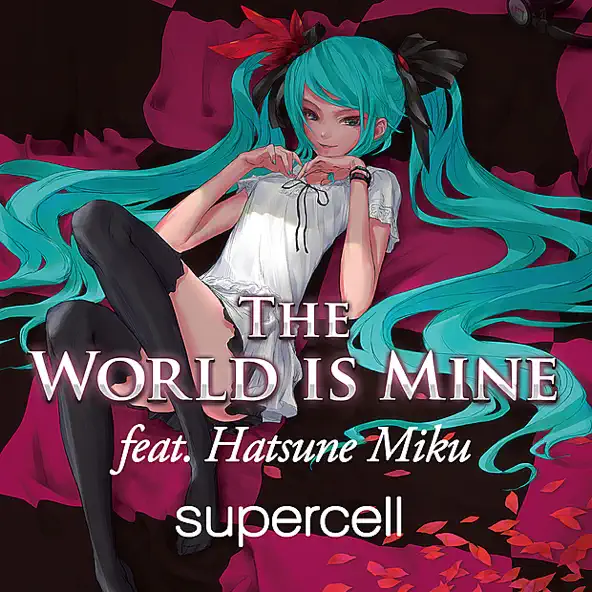
Anyway. I don't want to say too much, but let's talk about that yuri, because, because, jbkjkhjblgjkh, gosh.
Yuri is something present very early on in Cosmic Princess Kaguya as potential subtext. Iroha has been a long-time supporter of her favorite idol, the anime's tritagonist Yachiyo, with a fervor that could be read as a fan, but also as a crush... and the crush part gets stronger and stronger the more they're shown interacting.
I mean-- look at this embodiment of gay panic.

But the heart of the yuri lies mostly in Iroha's relationship with her impromptu alien(???) roommate Kaguya (once the whole "taking care of a baby" part is behind us, that is).
The two quickly develop some good chemistry, with Kaguya tearing down Iroha's walls as a model student, and Iroha reining in Kaguya's reckless ideas; but throughout the first half of the movie, I was wondering whether the yuri reading was on me. Even as they were slowly settling into an intimate domesticity that I would qualify as quietly lesbian - "why'd we even bother getting separate bedrooms?" Iroha half-grumbles as they sleep in the same futon - I couldn't help but wonder whether this was meant to be what the movie wanted to convey. Heck, even as the two leads develop a "secret handshake" that looks, huh, really... really lesbian....... I was still wondering whether it was just me reading too much into this.


And then, around the middle of the movie, still high from a concert literally repurposing an emblematic straight Vocaloid love song into clear lesbian flirtation on stage, Kaguya directly says to Iroha that she loves her. Granted, she uses the infamously versatile "好き (suki)", but it is immediately followed by an offhanded marriage proposal, that Iroha doesn't shoot down.
From that point on, the movie really crosses a sapphic threshold; and, imagine me saying this starry-eyed, never goes back on that. No, it shoots for the moon instead.
Now, the movie never gets a big kiss signifier. But it repeats its secret lesbian handshake regularly, has several scenes of meaningful handholding which are extremely emotionally charged, and has occurrences of Kaguya saying to Iroha she "looks beautiful in everything" or saying Iroha's face is so pretty she fell in love at first sight.
It's textually here.
It also has, in some of its most moving climaxes, Kaguya repeating to Iroha that she loves her (using the very loaded "大好き (daisuki)"); and Iroha saying things like this:

It's--
I--
Gosh.
It's a lesbian romance movie, y'all.
And you know what the best thing is?
It's that this lesbian romance is central to understanding the movie.
Because Cosmic Princess Kaguya is, at its core, in constant dialogue with the original Tale of the Bamboo Cutter. At first, this happens through fun little modern references to the finding of baby Kaguya in a bamboo shoot or the trials for marriage proposals; but in the background, there is always the same looming question: is Kaguya really from the moon? Are the lunarians going to get her back, as the tale foretells? Is there a happy ending to find there at all?
For a long while, the two girls joke over this, as something they vaguely keep in mind between two of Kaguya's happy-go-lucky antics. They criticize the original tale's moral of letting go of fun and attachment as an outdated bit of tragedy, and they go on to joyously defy fate together by becoming online idols.
But then this sword of Damocles falls into place exactly as Kaguya and Iroha's story cements into a romance, precisely because it does - because Kaguya experienced some really meaningful material attachment, and needs to leave Earth, now.
And this adds a new layer both to the Tale of the Bamboo Cutter's original ending, and to the two girls' determination to fight against it. Because then, the story of the princess Kaguya is a lesbian love story. Then, the inevitable parting waiting down the road is in line with both the original tale AND with tragic lesbian romance tropes.
And seeing our two leads heartbroken by the weight of this parting in some of the most emotionally heavy (and gayest) scenes of the movie is breathtaking. Seeing them steel their resolve to defy that fate is incredible.
In my opinion, the very best moments of the movie lie there, and they're so much worth watching.
Granted, the very end of the movie is a mess - once again, Cosmic Princess Kaguya really juggles too many ideas at the same time. But it's a heartfelt mess. It weaves a reflection on Kaguya's tale into a very sincere rejection of tragic queer tropes4; and it is adamant, again and again, about being a love story - by making its ending stakes absurdly romantic some more, just in case.
Cosmic Princess Kaguya is a confusing, cluttered bundle of way too many things at once; but a vibrant tribute to all those things all the same. I often wish it would settle to flesh out the ideas (and characters) it sketches, but I love it still for the one it holds tightest: twisting Kaguya's tale into a coming-of-age story of lesbian love against fate.

And that makes me happy, and strangely giddy, knowing that it exists.
Three small things, before ending this post.
First thing: funnily enough (not that much, actually), one week ago we were listing with my lover how many standalone animated movies we knew with significant queer characters. While LGBT+ representation has been increasing in most media overall, we shockingly realized just then how much this tended not to be true in animated movies - sadly, probably due to them being more easily marketed toward children than, say, live-action series or most books5. We ended up finding less examples than what we could count on one hand6, while being decently knowledgeable on the topic in different ways; and this feels so scary.
Somehow, thinking that Cosmic Princess Kaguya fits in there - depending on how much you want to argue about subtext when girls talk about marrying, loving each other and wanting to be together - is comforting, in a sense.
Second thing: Iroha's in-game skin is a foxgirl. Makes me happy. Where do we sign to be a similarly badass foxgirl in a VRMMO??
Additionally, as evidenced above, the two's "secret handshake" also contains a "kissing foxes" hand gesture, which says a lot in that context. And all the more when - I'm discovering with absolute amazement as I'm writing this - this is tied to meaning kiss in Japanese Sign Language?!
So... yeah. Just saying. They're lesbians.
Third thing: all in all, maybe the actual best thing about Cosmic Princess Kaguya is that it reveals to the world an important truth that the Touhou fandom has known for almost twenty years: Princess Kaguya is a NEET, and she is really fucking gay.
not actually League of Legends of course, but a MOBA specific to the movie; it's just that LoL remains the main representative of the genre in my mind.↩
There's also one thing very late in the movie: a minute-long scene with apparent bottles for a fizzy beverage named "Pop-Cola" in the foreground which really, really feels like a barely-disguised product placement for Coca-Cola considering their overly-detailed Coke-like appearance. This makes me mad: Coca-Cola explicitly supports Israel's genocide and genocidal endeavor in Palestine, and you should boycott it. I couldn't entirely ascertain that this scene from the movie was meant to be product placement, but it feels rather clear - or at least obvious enough to make me really uncomfortable. This kind of thing in 2026 is absolutely horrendous, and I considered not posting this post altogether; but I thought being upfront on this may be the best solution. I'll use this note instead to recommend you to stay informed on the situation in Palestine, where Israel continues to kill Palestinians - both in Gaza despite the alleged ceasefire, and in the West Bank along with forced displacements and movement restrictions - and to gravely restrict their access to humanitarian aid. This has to end.↩
even if Belle is the easier comparison here overall, for its focus on singing and concerts.↩
This made me think of Revue Starlight's similar endeavor, somehow.↩
This absence is also palpable in books targeted toward children. The idea that LGBT+ themes are not suited for children is an incredibly hurtful and conservative vision that purposefully prevents so many of us to find words and concepts earlier to understand ourselves. Seeing how prevalent it still tends to be (or is re-gaining traction, considering the general rise of traditionalist right-wing politics going on), it really makes me want to burn societies down.↩
Our list contained Tokyo Godfathers (2003) and Nimona (2023) that we (or I) had watched, and The Mitchells vs the Machines (2021) and Lesbian Space Princess (2025) that we hadn't (and I really don't want to watch the latter. That's all. We also half-counted Liz and the Blue Bird (2018), where the representation is on the verge of text, and which is only partially a standalone movie, as it's actually part of the Sound! Euphonium series. We purposefully excluded any movies part of a series in general (think things like the Utena movie or the Steven Universe movie, for instance), as their accessibility tends to be conditioned by the access to the series itself. We are interested if you know of other instances: Internet has not really been our friend on this - though as I'm trying to look for more when writing this, maybe we can find a few more still. It's been draining, and oh so telling, to realize this.↩